Questions

Q:

A cappella refers to

A) Literature B) Music
C) Arts D) War
 
Answer & Explanation Answer: B) Music

Explanation:
Report Error

View Answer Report Error Discuss

Filed Under: General Science
Exam Prep: AIEEE , Bank Exams , CAT
Job Role: Analyst , Bank Clerk , Bank PO

0 2991
Q:

What is the world’s oldest surviving republic?

Answer

San Marino

Report Error

View answer Workspace Report Error Discuss

Subject: World History

5 2991
Q:

What is the only chain we can eat ?

Answer

A food chain is the only chain we can eat.

Report Error

View answer Workspace Report Error Discuss

Subject: Word Puzzles Exam Prep: Bank Exams

3 2991
Q:

Which of the following reactions are redox reactions?

A) Ba(s)+Cl2(g)--->BaCl2(s) B) Mg(s)+Br2(l)--->MgBr2(s)
C) Al(s)+3Ag^+(aq)--->Al^3+(aq)+3Ag(s) D) All of the above
 
Answer & Explanation Answer: D) All of the above

Explanation:

A redox reaction is a type of reaction which involves transfer of electrons among two species. This reaction is also called oxidation-reduction reaction.

In oxidation process, there is an increase in oxidation state of an atom, ion or molecule by losing the electrons.

In reduction process, there is a decrease in oxidation state of an atom, ion or molecule by accepting the electrons.

1)
image

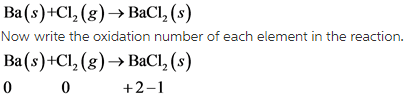
In this reaction, Ba undergoes oxidation and Cl undergoes reduction.
This reaction is redox reaction.
In this reaction, oxidation number of Ba increases from 0 to +2 . So, Ba undergoes oxidation. The oxidation number of Cl decreases from 0 to -1. So, Cl undergoes reduction.


2) 
 

image

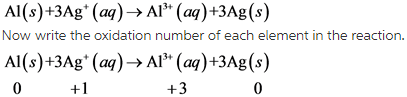
From this above reaction, it is clear that Aluminum undergoes oxidation and silver undergoes reduction.
Due to this, this reaction is redox reaction.

In this reaction, oxidation number of Aluminum increases from 0 to +1. So, aluminum undergoes oxidation. The oxidation number of silver decreases from +1 to 0. So, silver undergoes reduction.


3)

image

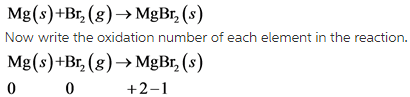
In this reaction, Mg undergoes oxidation and Br undergoes reduction.
This reaction is redox reaction.
The reactions 1, 3 and 4 are redox reactions.
In this reaction, oxidation number of Mg increases from 0 to +2 . So, Mg undergoes oxidation. The oxidation number of Br decreases from 0 to -1 . So, Br undergoes reduction.


Hence all the above reactions are redox reactions.

Report Error

View Answer Report Error Discuss

Filed Under: Chemistry
Exam Prep: AIEEE , Bank Exams , CAT , GATE
Job Role: Analyst , Bank Clerk , Bank PO

1 2990
Q:

What was one outcome of laissez faire economic policies?

A) Poverty traps that cannot be escaped through free choice B) Monopoly power that emerges naturally in the market and allows businesses to exploit consumers
C) Businesses pay workers low D) All of the above
 
Answer & Explanation Answer: D) All of the above

Explanation:

Laissez-faire is simply a way to describe a government's hands-off approach to economic policies. This approach was particularly prevalent in the United States at the turn of the 20th century, which led to numerous issues within American manufacturing.


There are many outcomes of laissez-faire economic policies. Some of the outcomes of laissez-faire economics were:

* Businesses pay workers low.

* Pollution of air and water.

* Poverty traps that cannot be escaped through free choice. 

* General glut that results from overproduction or underconsumption

* Monopoly power that emerges naturally in the market and allows businesses to exploit consumers. 

* Exploitation of the working class that pushes wages down to subsistence and compels laborers to work in harsh and unsafe conditions. 

* External economies that generate situations where desirable goods are underproduced on the market, and undesirable goods are overproduced on the market. 

* Public goods that are not supplied by the market due to free-rider problems.

Report Error

View Answer Report Error Discuss

Filed Under: Indian Economy
Exam Prep: AIEEE , Bank Exams , CAT
Job Role: Analyst , Bank Clerk , Bank PO

1 2990
Q:

Which subatomic particle has no charge?

A) electron B) neutron
C) proton D) All of the above
 
Answer & Explanation Answer: B) neutron

Explanation:

An atom is composed of three subatomic particles. They are ::


1) Electron (-vely charged particle)

2) Proton (+vely charged particle)

3) Neutron (No charge particle)


Hence, Neutron is the subatomic particle which has no charge.

Report Error

View Answer Report Error Discuss

Filed Under: General Awareness
Exam Prep: AIEEE , Bank Exams , CAT , GATE
Job Role: Analyst , Bank Clerk , Bank PO

2 2989
Q:

Words to describe a beautiful woman?

A) Gorgeous B) Cute
C) Elegant D) All of the above
 
Answer & Explanation Answer: D) All of the above

Explanation:

Words to describe a beautiful woman are :: appealing, fair, charming, fascinating, dazzling, fetching, angelic, fine, delicate, delightful, divine, beauteous, ...

Report Error

View Answer Report Error Discuss

Filed Under: English
Exam Prep: Bank Exams , CAT , GATE , GRE , TOEFL
Job Role: Analyst , Bank Clerk , Bank PO

1 2988
Q:

Which of the following is an example of chemical weathering?

A) Oxidation B) Acid rains
C) Carbonation D) All the above
 
Answer & Explanation Answer: D) All the above

Explanation:

Chemical weathering is what happens when rocks are broken down and chemically altered.

Chemical weathering is the breakdown of rocks by chemical reactions. Chemical weathering involves changes in the chemical composition of the existing rock to form new rock. Some examples of chemical weathering are hydrolysis, oxidation, carbonation, dissolution, etc.

Report Error

View Answer Report Error Discuss

Filed Under: Chemistry
Exam Prep: AIEEE , Bank Exams , CAT , GATE
Job Role: Analyst , Bank Clerk , Bank PO

1 2987










