General Knowledge Questions

Q:

The upper part of the mantle upon which the crust of the earth floats is called

A) Barysphere B) Mesosphere
C) Mohorovic discontinuity D) Asthenosphere
 
Answer & Explanation Answer: D) Asthenosphere

Explanation:
Report Error

View Answer Report Error Discuss

Filed Under: World Geography

20 11972
Q:

Breeding and management of bees is called

A) Pisciculture B) Sericulture
C) Silviculture D) Apiculture
 
Answer & Explanation Answer: D) Apiculture

Explanation:

Breeding and management of bees is called Apiculture.


A beekeeper or apiarist keeps bees in order to collect their honey and other products that the hive produces (including beeswax, propolis, flower pollen, bee pollen, and royal jelly), to pollinate crops, or to produce bees for sale to other beekeepers.

A location where bees are kept is called an 'apiary' or 'bee yard.'

Report Error

View Answer Report Error Discuss

Filed Under: General Awareness
Exam Prep: AIEEE , Bank Exams , CAT
Job Role: Analyst , Bank Clerk , Bank PO

10 11953
Q:

 What is the name of the virus that fool a user into downloading and executing them by pretending to be useful applications  ?

A) Trojan horses B) Keylogger
C) Worm D) File virus
 
Answer & Explanation Answer: A) Trojan horses

Explanation:
Report Error

View Answer Report Error Discuss

Filed Under: Computer
Exam Prep: Bank Exams , CAT
Job Role: Analyst , IT Trainer

32 11933
Q:

Total internal reflection can take place when light travels from

A) Air to glass B) Air to water
C) Water to glass D) Diamond to glass
 
Answer & Explanation Answer: D) Diamond to glass

Explanation:
Report Error

View Answer Report Error Discuss

Filed Under: Physics

39 11933
Q:

Most abundant tissue in the body

A) Connective B) Nervous
C) Muscular D) Epithelial
 
Answer & Explanation Answer: A) Connective

Explanation:

We know that, there are four types of tissue in human body. They are 


1.Muscular
2.Connective
3.Epithelial
4.Nervous


Among these Connective Tissue are most abundant in our body


CONNECTIVE TISSUE

Most_abundant_tissue_in_the_body1552975117.jpg image


Connective tissue is found in between other tissues everywhere in the body, including the nervous system. It develops from the mesoderm.


Functions:

1) Wraps around and cushions and protects organs
2) Stores nutrients
3) Internal support for organs
4) As tendon and ligaments protects joints and attached muscles to bone and each other
5) Runs through organ capsules and in deep layers of skin giving strength


The 3 Elements of Connective Tissue are

1) Ground substance – gel around cells and fibers
2) Fibers – provide strength, elasticity and support
3) Cells


Report Error

View Answer Report Error Discuss

Filed Under: Biology
Exam Prep: AIEEE , Bank Exams
Job Role: Analyst , Bank Clerk , Bank PO

43 11924
Q:

What kind of crystalline solid is graphite?

A) Metallic B) Ionic
C) Molecular D) Covalent- network
 
Answer & Explanation Answer: D) Covalent- network

Explanation:

Graphite is a covalent-network type of crystalline solid.


There are two main categories of solids.

1. Crystalline solids and

2. Amorphous solids.

Crystalline solids are those in which the atoms, ions, or molecules that make up the solid exist in a regular, well-defined arrangement.

There are four types of crystalline solids :


Ionic solids :— Made up of positive and negative ions and held together by electrostatic attractions. They’re characterized by very high melting points and brittleness and are poor conductors in the solid state. An example of an ionic solid is table salt, NaCl.

Molecular solids :— Made up of atoms or molecules held together by London dispersion forces, dipole-dipole forces, or hydrogen bonds. Characterized by low melting points and flexibility and are poor conductors. An example of a molecular solid is sucrose.

Covalent-network (also called atomic) solids :— Made up of atoms connected by covalent bonds; the intermolecular forces are covalent bonds as well. Characterized as being very hard with very high melting points and being poor conductors. Examples of this type of solid are diamond and graphite, and the fullerenes. As you can see below, graphite has only 2-D hexagonal structure and therefore is not hard like diamond. The sheets of graphite are held together by only weak London forces!

Metallic solids :— Made up of metal atoms that are held together by metallic bonds. Characterized by high melting points, can range from soft and malleable to very hard, and are good conductors of electricity.

Report Error

View Answer Report Error Discuss

Filed Under: Physics
Exam Prep: AIEEE , Bank Exams , CAT , GATE , GRE
Job Role: Analyst , Bank Clerk , Bank PO

16 11918
Q:

Who invented Radar?

A) Henrey Backquerel B) Max Planck
C) Robert Watson Watt D) Humphrey Davy
 
Answer & Explanation Answer: C) Robert Watson Watt

Explanation:

Who_invented_Radar1556273104.jpg image

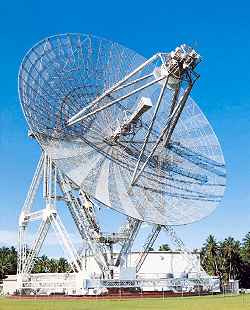
RADAR stands for Radio Detection and Ranging.

Radar is a detecting system that uses radio waves to determine the range, angle, or velocity of objects. It operates in the ultra-high-frequency of the radio-frequency (RF) spectrum.


Uses ::

To detect

aircraft,

ships,

spacecraft,

guided missiles,

motor vehicles,

weather formations, and

terrain.

Report Error

View Answer Report Error Discuss

Filed Under: Inventions
Exam Prep: CAT , Bank Exams , AIEEE
Job Role: Bank PO , Bank Clerk , Analyst

18 11916
Q:

The metal which reacts most violently with with cold water is

A) calcium B) sodium
C) magnesium D) potassium
 
Answer & Explanation Answer: D) potassium

Explanation:

Potassium reacts violently with water liberating hydrogen. The reaction is so violent that the liberated hydrogen catches fire.

Report Error

View Answer Report Error Discuss

Filed Under: Chemistry

47 11913